

“You must change your life.” The title of the 16th Gwangju Biennale arrives with the force of an instruction. The title comes from the final line of Rainer Maria Rilke’s 1908 ekphrastic poem Archaic Torso of Apollo, presented at the entrance. Confronting a fragment of ancient sculpture, the speaker discovers an object that seems capable of looking back. The sudden instruction at the poem’s close is unsettling: looking becomes an encounter in which the viewer is also addressed. It leaves the visitor to determine what needs changing, and how. I recall one of Heraclitus’ fragments, No man ever steps in the same river twice. If change is inevitable and often beyond control or by choice, how much of what we have been, do we carry into what we become?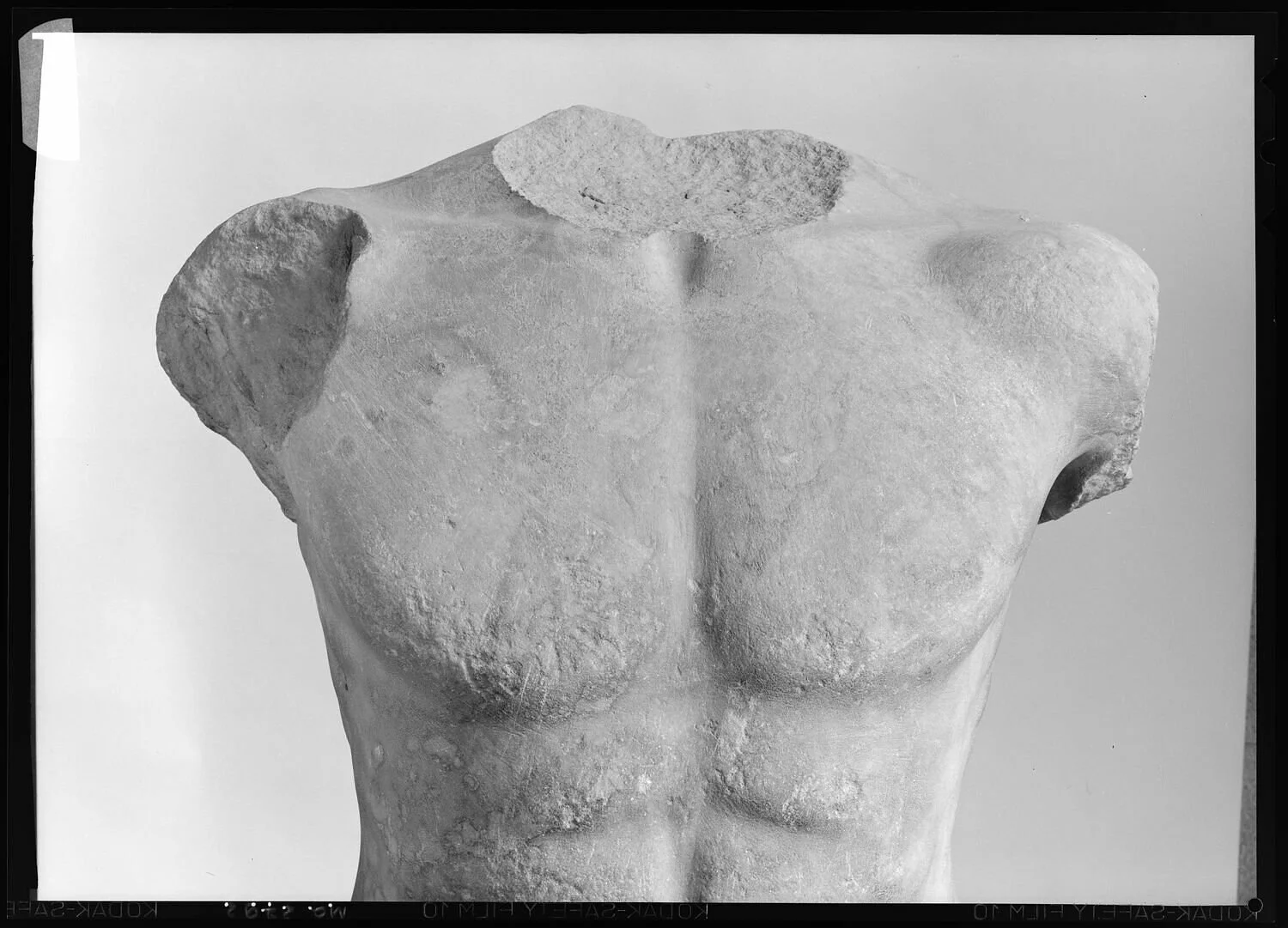
Torso de Milet, C 480-470 BCE, Collection of Musee du Lourve
Under artistic director Ho Tzu Nyen, working with curators Che Kyongfa, Park Gahee and Brian Kuan Wood, the exhibition brings together 43 artists and groups. Its five sections move from molecules and bodies towards landscapes, the cosmos and air. These shifts in scale give the title’s demand room to unfold beyond an individual life. How the exhibition might sustain that demand across five galleries is a difficult proposition. It is most persuasive when it brings its expansive concerns back to something close at hand: a mat, a marked branch, the changing face of someone we love.

In the opening section, “Molecules and Me”, Sasaki Ken’s paintings of mats, rags and towels bring forth objects that usually recede into use. Tatami (2025) held my attention. Rendered in paint, the familiar object becomes available for scrutiny beyond its function. A surface for sitting also arranges the body; it establishes a height, a posture, a way of inhabiting a room. I was reminded of the extent to which domestic life is learnt through contact with such surfaces, long before we think to interrogate them. The exhibition guide also connects the tatami to the spread of Japanese domestic interiors under colonial rule. That history complicates an easy identification of the mat with tradition or belonging. What feels intimate and habitual can bear the traces of authoritative power. The paintings leaves room to consider how a domestic object becomes familiar, and whose histories accompany that familiarity. 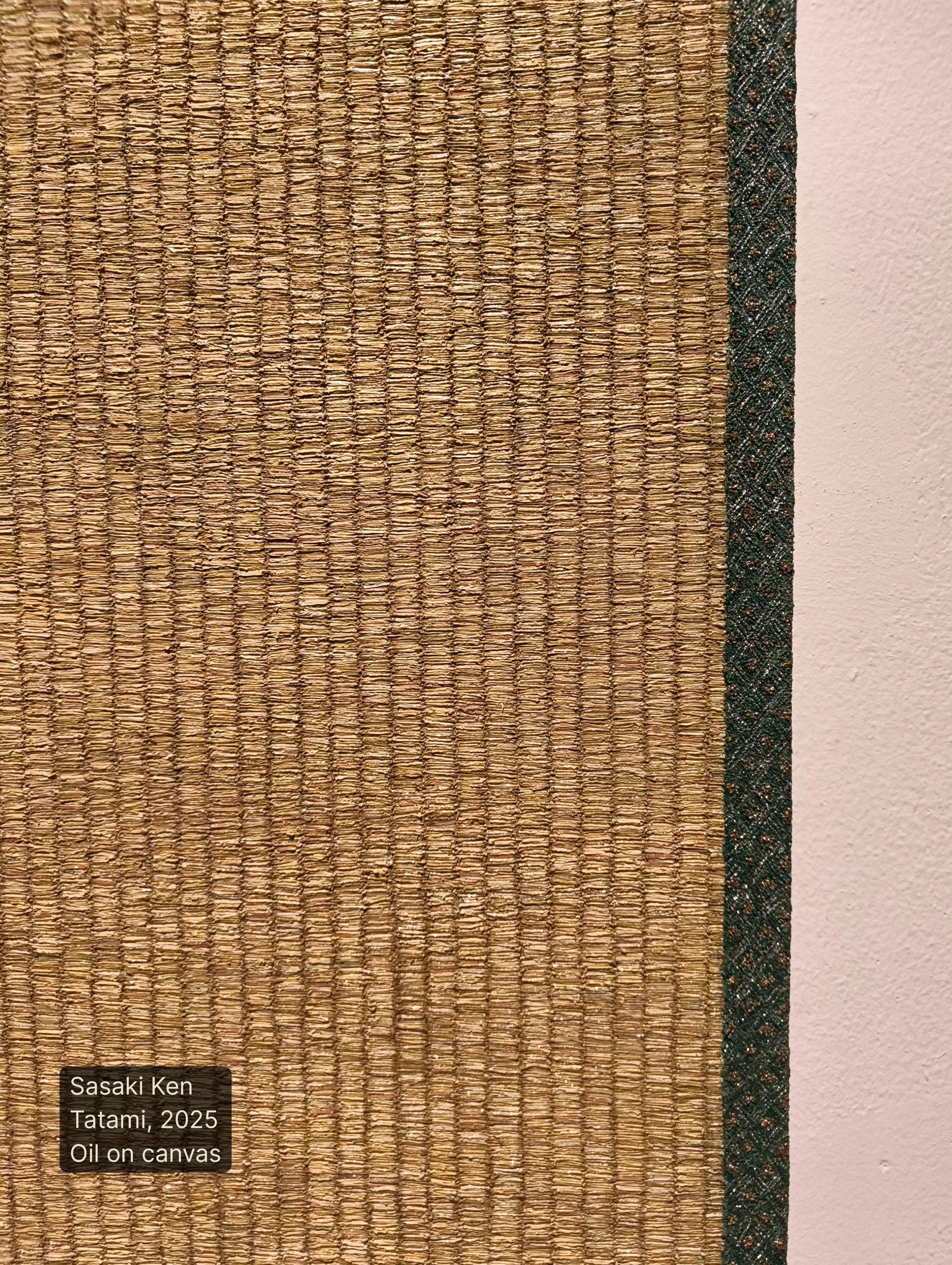
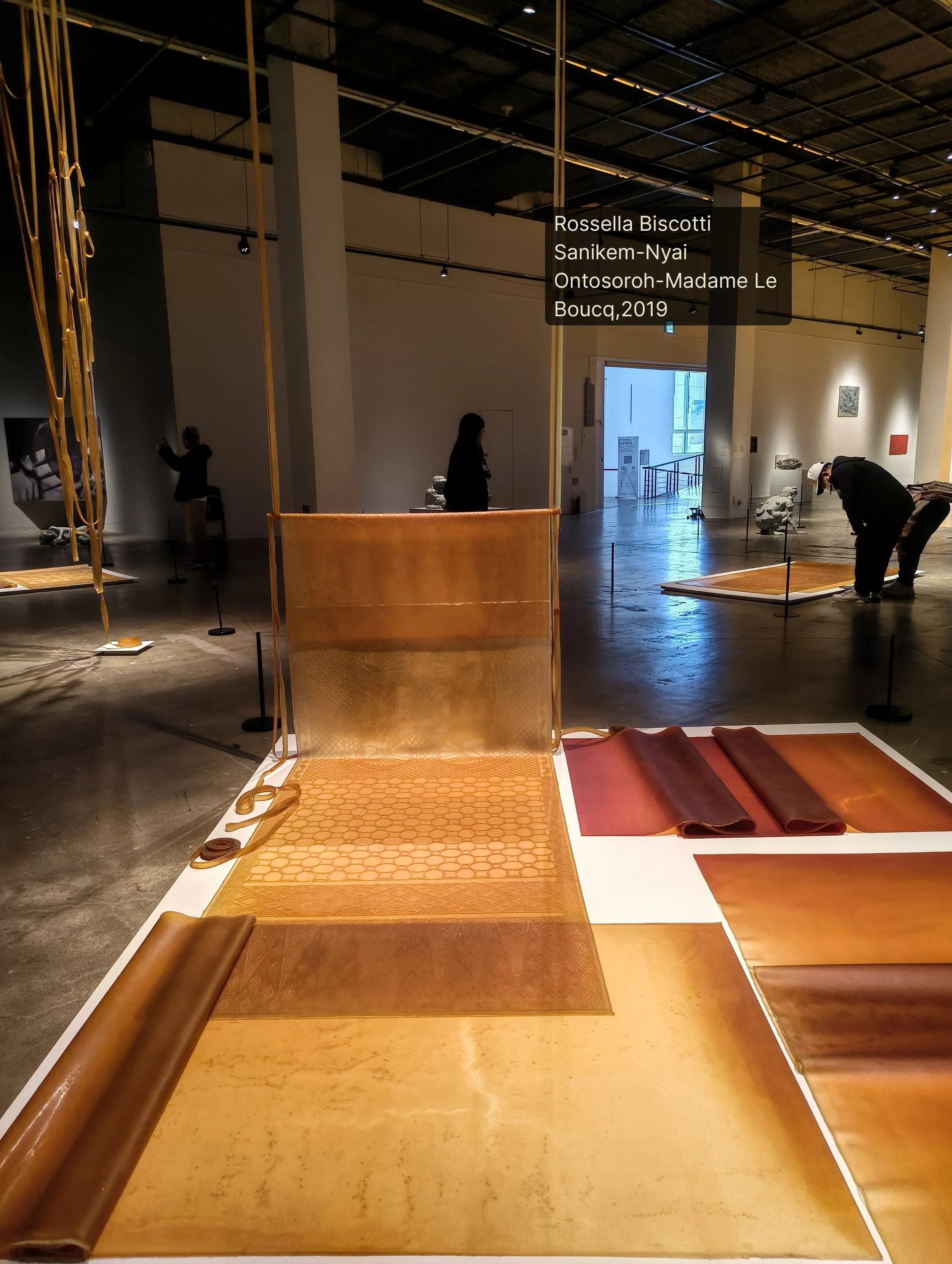
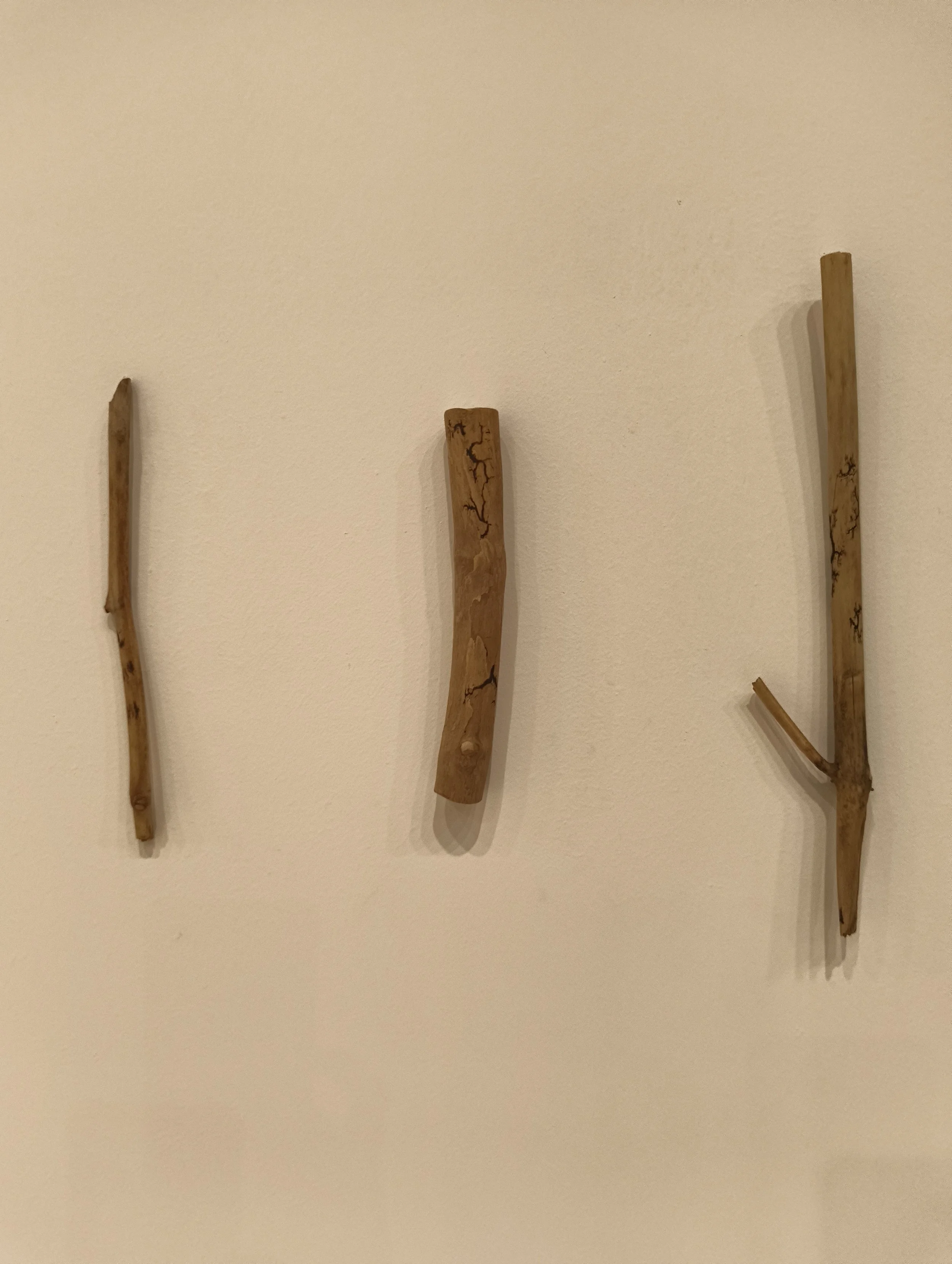
L to R: Works by Sasaki Ken, Rosella Biscolli and Nina Canell
Rossella Biscotti’s rubber works introduce a more explicit account of bodies subjected to change under colonialism. Loosely hanging sheets evoke flayed skin, their material vulnerability sharpened by the women they stand for. The works draw on characters from Pramoedya Ananta Toer’s Buru Quartet, set within the racial and social hierarchies of Dutch colonial Indonesia. In Sanikem–Nyai Ontosoroh–Madame Le Boucq (2019), the sequence of names suggests a life repeatedly recast through its relations to others. Rubber carries the histories of plantation labour and extraction into this account of a woman’s changing identity. The freedom implied by the injunction to change becomes uncertain. A life may be transformed by conditions its subject has little power to choose.Elsewhere, Nina Canell’s Halfway Between Opposite Ends (2011–2026) initially resembles a collection of unremarkable branches. A second look reveals dark, branching marks across the wood that resemble scars. The material has been exposed to electrical current; these apparently natural details are the traces of an intervention. Change can leave a body recognisable while altering what it carries. These small pieces of wood make an otherwise invisible passage of energy legible through its aftermath. 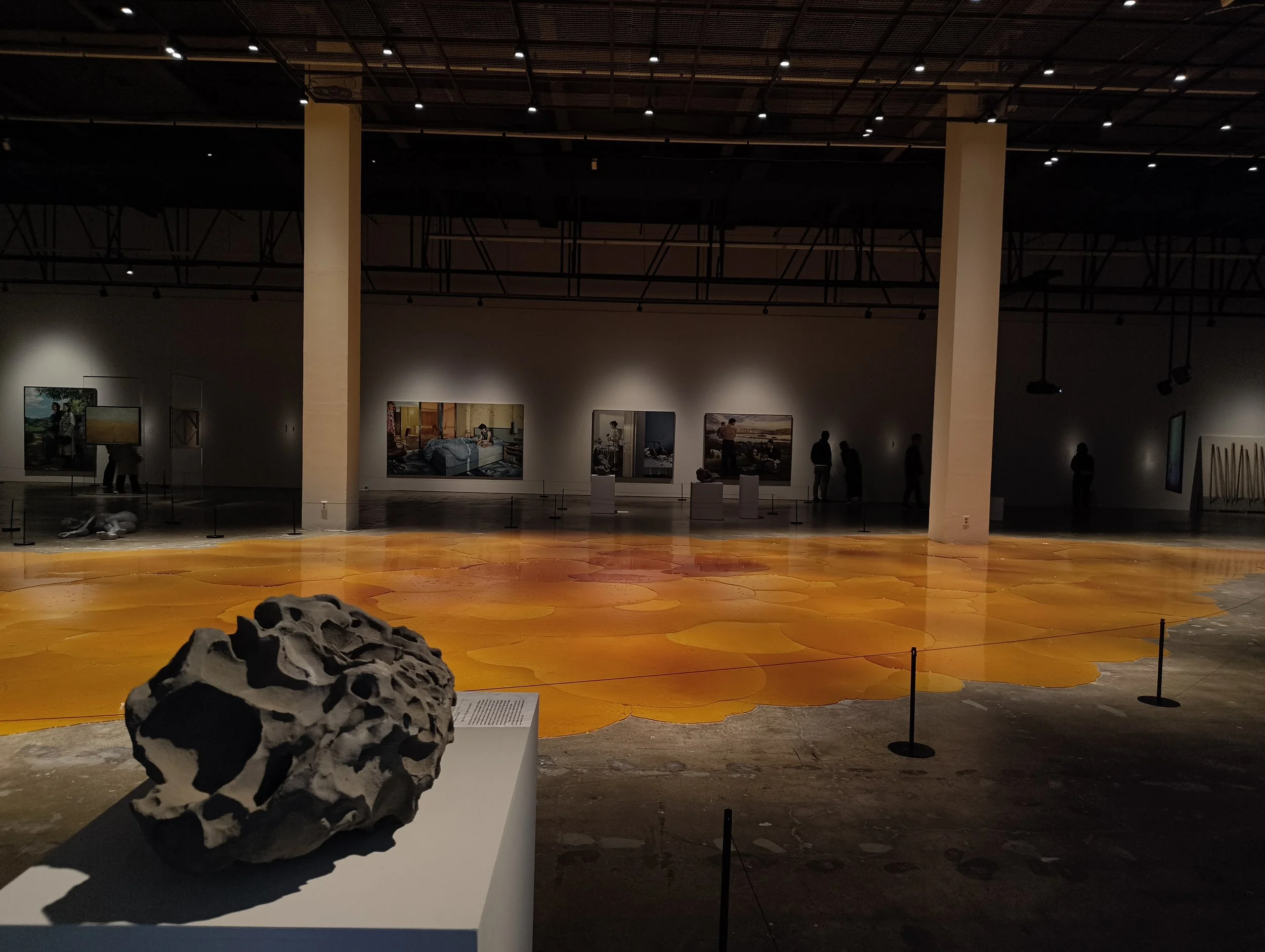
Volcanic rock, Tafoni is in the foreground with Goldin+Senneby’s Resin Pond (2026) at the back
And you can’t leave the first gallery without taking another look at Goldin+Senneby’s Resin Pond (2026). It spreads nearly two tons of pine resin across the floor in a luminous amber pool. Its abundance is seductive, but the substance’s protective function gives the spectacle an uneasy charge. Within a tree, resin helps seal wounds and repel threats. At this scale, it becomes an obstruction. The work makes it difficult to equate more with better, or protection with an unqualified good.

Volcanic rocks from Jeju recur across the exhibition, returning my thoughts to Rilke’s poem. The rocks hold the results of eruption, cooling and weathering in their forms. Their presence places the urgency of the title against durations that exceed a human life. Alongside Canell’s marked wood and Biscotti’s suspended sheets, it extends the first gallery’s probe with the atomical processes through which bodies are made of, sustained and altered. Change is already there, although its timescale sometimes resists the expectation of a visible aftermath.
That expectation becomes more intimate in “Bodies and Bonds”. I was glad to encounter Amanda Heng’s photographic work in fuller form here. Another Woman in Gwangju 1996, 2014, 2023 (2026) brings together photographs of the artist and her mother made across 27 years. Changes in their faces and expressions become perceptible through comparison. Looking between the images, I was struck by the difficulty of noticing such changes in the people we see most often. Familiarity can conceal time. Heng’s work also complicates the suggestion that becoming someone else requires leaving an earlier self behind. The relationship may persist through photographs, but the bodies cannot defy time. Repetition makes that difference visible. Within an exhibition organised around transformation, the series gives continuity an emotional weight of its own. What we carry may be a relationship, sustained through the uneven passage of time.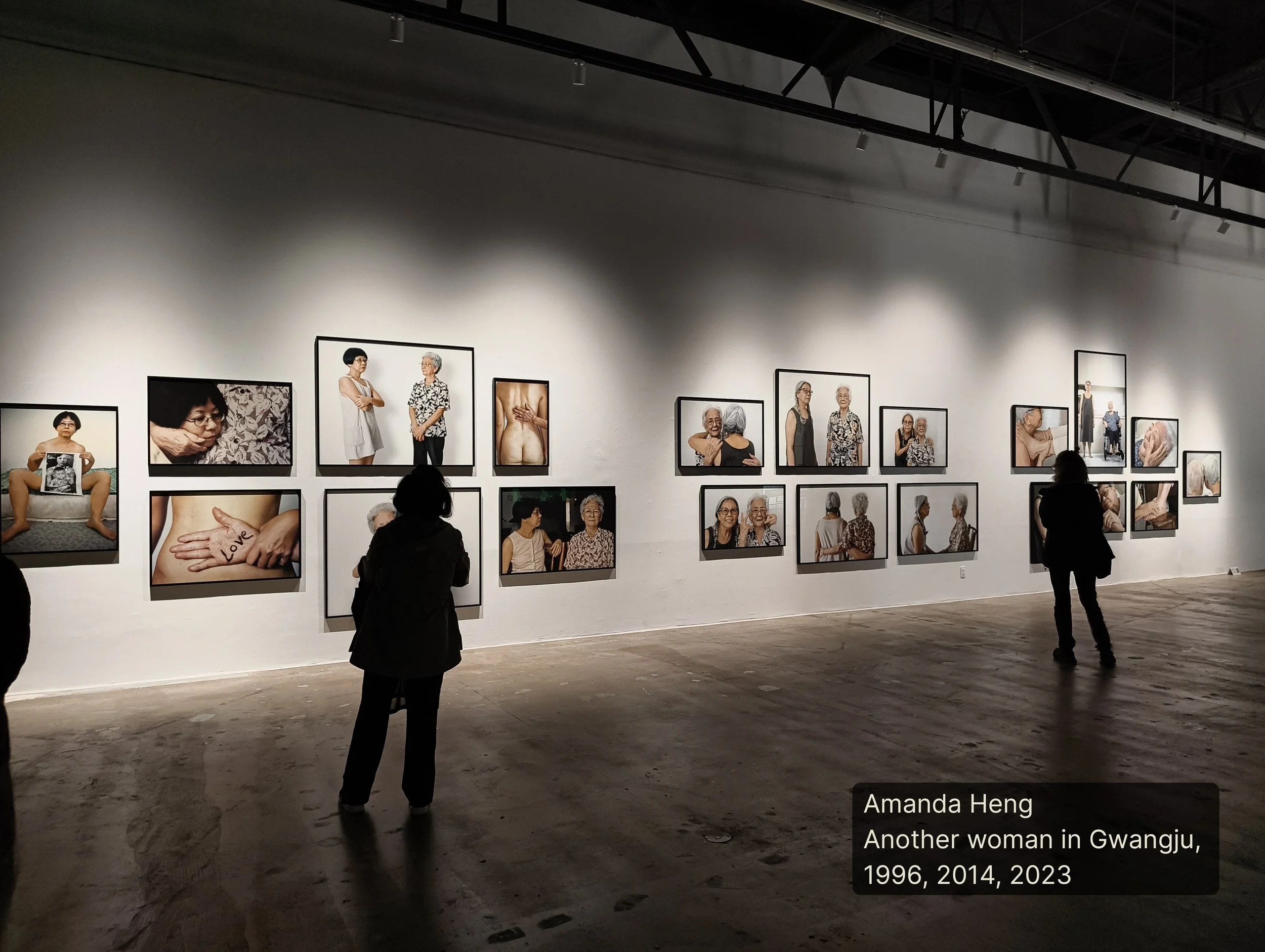
At the centre of the gallery stands a wall of small square paintings. From a distance, their colours resemble a patchwork quilt, and I had initially mistaken them for children’s drawings. They were made by members of May Mothers House, a community of women whose lives were impacted by the 1980 Gwangju Uprising and its violence. Created through workshops led by artist Joo Hong addressing themes like “Remembering”, “Finding Myself” and “Solidarity”, the paintings include gatherings, blooming flowers and smiling women. My first impression sits uneasily beside the lives and memories these paintings record. Their apparent simplicity offers little indication of the histories behind them, but they hold immense courage and persistence of living with trauma and absence of a loved one. (My picture didn’t do it justice, so here’s a better photo from MetroTVNews from Indonesia)

The third gallery, “Landscapes and Learning”, turns our gaze beyond the window, into the environment around us and our relationship with a place. Can farming influence the making of art, and vice versa? Rim Dong Sik’s practice in Wongol Village gives that question a concrete setting. In Drawing and Paying Reverence to the Grandfather Tree of Bangheung-ri (2020–2021), the title joins artistic work to an act of regard and companionship. Accompanied by his friend and studio mate Woo Pyongnam’s collection of pine roots and paintings. The juxtaposition suggests how an environment can inform both a way of seeing and a method of working. The attention these practices give to a place helps make the connection between living and making tangible. The title’s urgency acquires a slower rhythm as I move through Huh Moon’s ink mountainscapes, their forms emerging through cloud. The history of Ullimsanbang, the studio and place of learning founded by Huh Ryeon on Jindo Island in 1857, gives these works a wider lineage. Across generations of painters, a practice rooted in place is constantly reinterpreted. The landscape offers a means of tracing how ways of seeing are learnt, inherited and revised.
In “Cosmos and Change”, the section I found most emotionally demanding, repetition becomes more insistent. Moving-image works involving dance and ritual gather bodily transformation into an intense field of sound and movement. I was absorbed by Rafik Greiss’s The Longest Sleep (2024), filmed at Egyptian mawlids celebrating Sufi saints. Swaying and turning bodies draw the eye into their repeated movements. Watching them, I felt myself caught by their rhythm before I could consciously understand the gestures. Lu Yang’s DOKU cycle approaches spiritual transformation through a digital avatar and Buddhist cosmology. Animation and motion-capture technology make the body available for repeated reinvention; DOKU the Creator (2025) also uses generative AI. Visually overpowering and stimulating, the works unsettled my association of spirituality with contemplation and serenity. Their intensity implies that spiritual enquiry might also involve agitation and sensory excess. Greiss’s filmed gatherings and Lu Yang’s animated worlds bring different forms of bodily experience into this question. Neither allowed me to remain a detached observer, although being absorbed by their images was not the same as understanding these practices and ideas they engaged.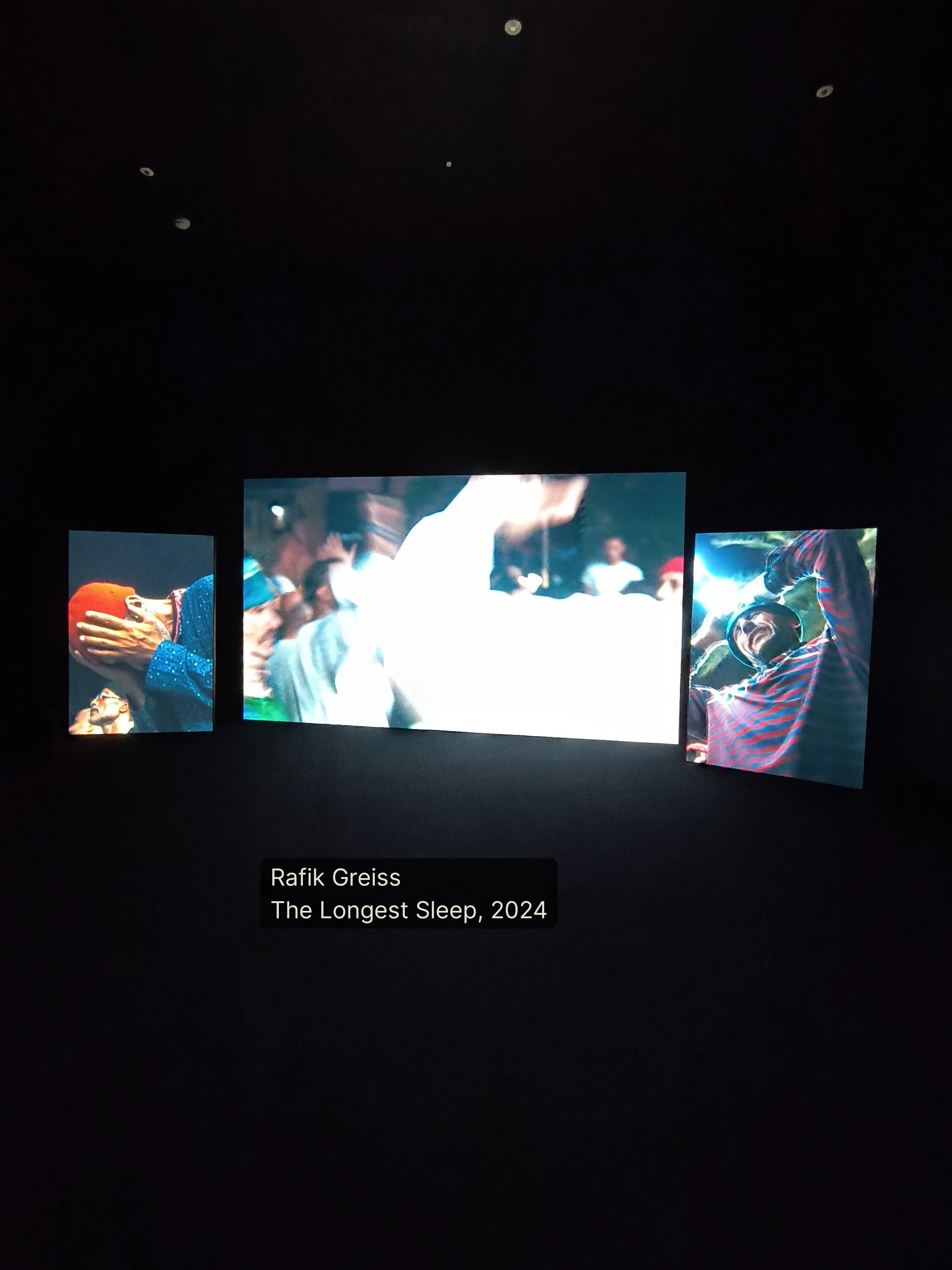
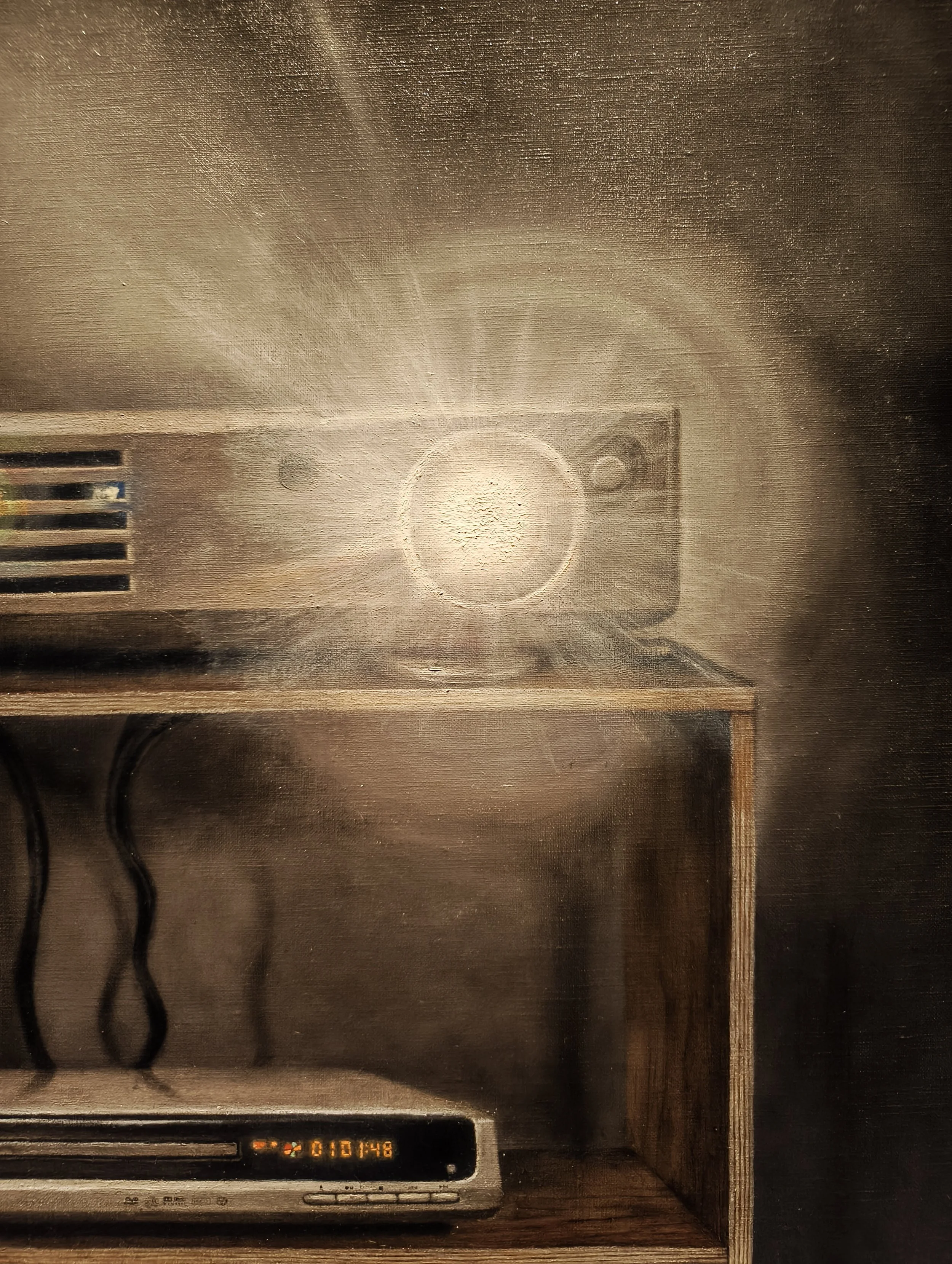
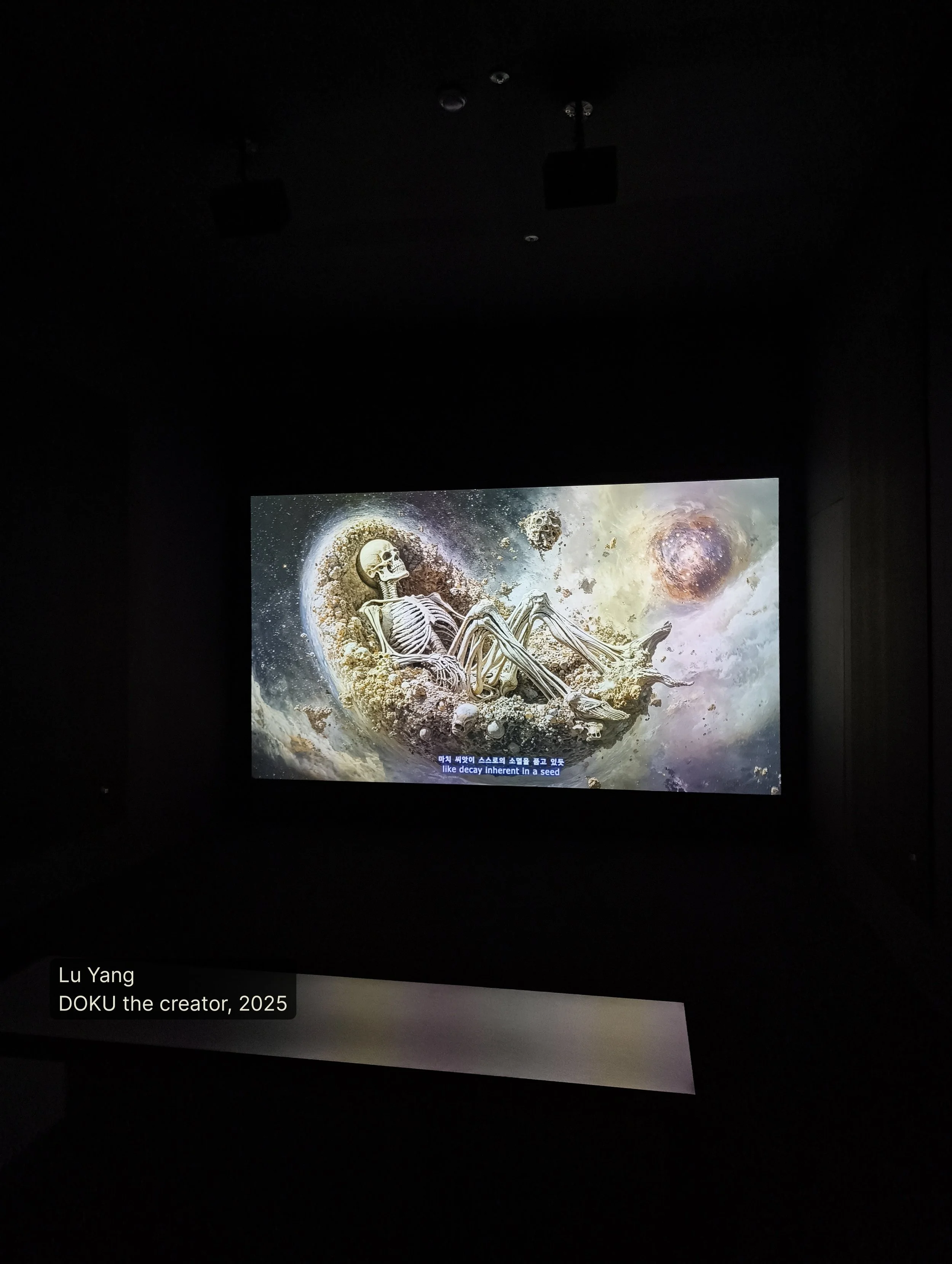
L to R: Film still from The Longest Sleep by Ralik Greiss, Painting by Sasaki Ken, Film still from DOKU the creator by Lu Yang
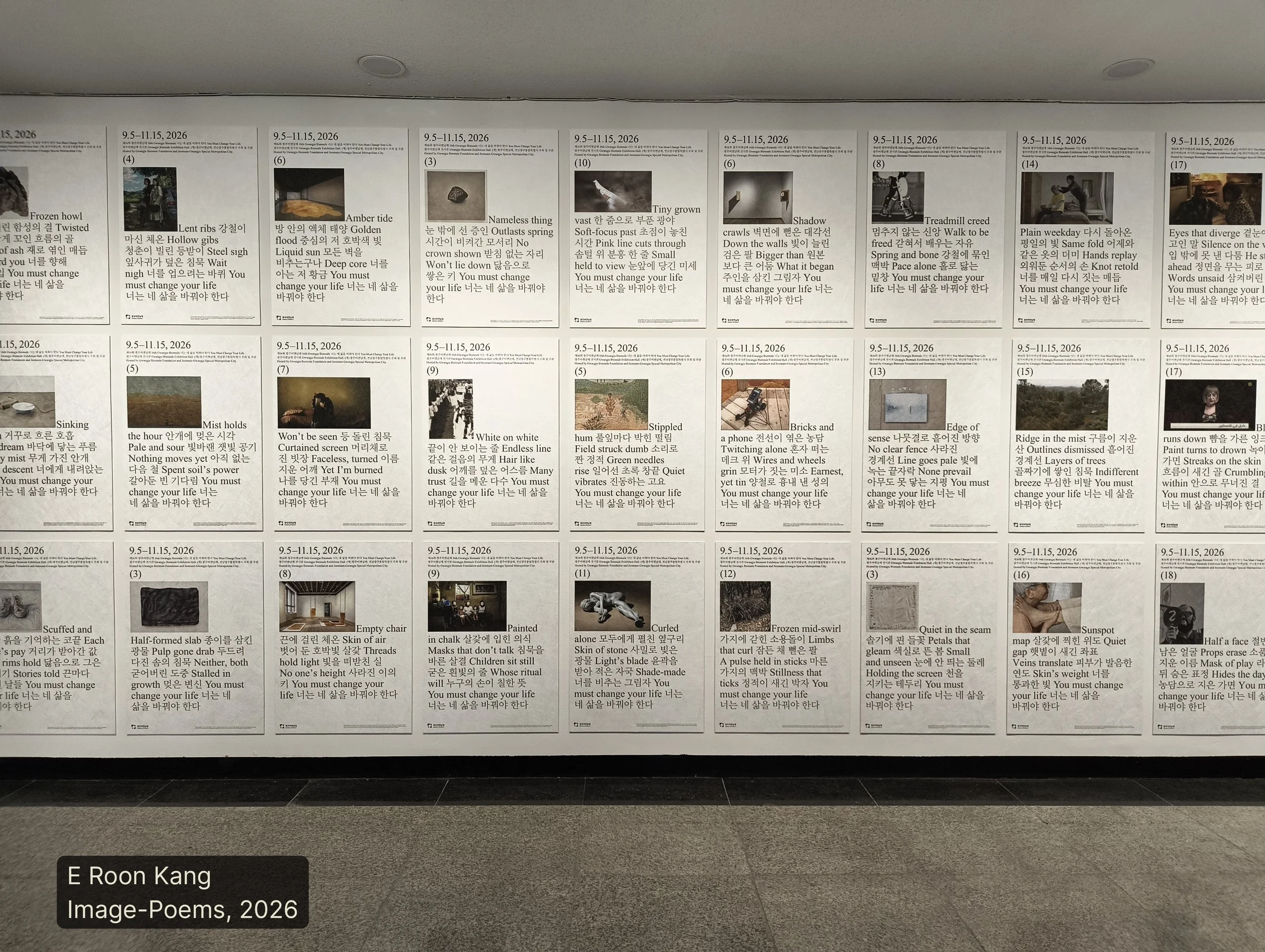
The exhibition’s final section, “Air and Articulations”, brings these questions back into the space around the visitor. Jacqueline Kiyomi Gork’s Not Exactly BPM (Variation Rrose) (2026) combines transparent inflatables, air blowers and multichannel sound in an environment I found immersive and engaging. Its form depends on forces moving through it: air has to keep circulating for the structure to maintain and alter its shape. The work offers a material way to think about the effort involved in sustaining change and form. The section pairs this installation with E Roon Kang’s Image-Poems (2026), posters displayed in the lobby that combine images of the participating artists’ works with AI-generated poems. A possible connection runs between the works through air, sound and the translation of images into language. Yet I found their relationship insufficiently developed to give the final chapter a clear identity. The move from Gork’s immersive environment to the posters in the entrance area left the theme less explored than its title suggested. The ending felt abrupt. 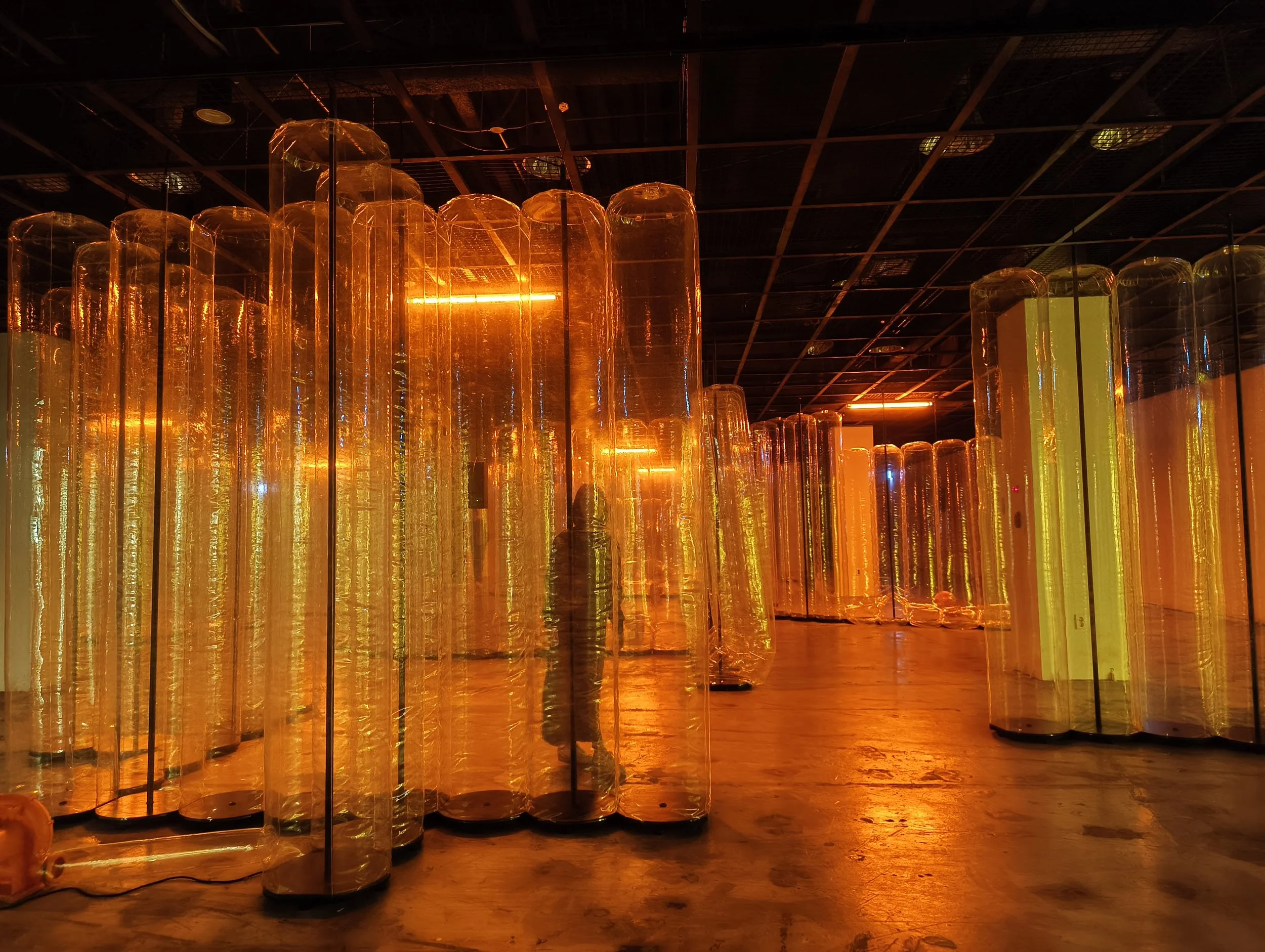
Sasaki’s recurring paintings had provided a convincing continuity through this uncertainty. Appearing across several galleries, they became familiar companions. Each return brought recognition, while their changing surroundings invited another reading. The experience reminded me of rewatching a film or rereading a book and leaving with a different understanding. Something previously overlooked comes forward while a familiar scene acquires another weight or meaning. I began to wonder how much of what I saw depended on what I had encountered along the way. I had hoped to meet Sasaki’s paintings once more in the final gallery, to have that familiar presence see us out. Its absence left me feeling briefly unaccompanied. From this point, we were left to continue our own.

The title’s demand remains difficult to assess at the exit. Life changes regardless. Our bodies age, relationships shift, and the world moves around us. Other seasons of ourselves are already taking shape, often before we recognise these changes or grasp the magnitude of its consequences. The Biennale was most compelling in its use of repetition as a curatorial method. Recurring works brought different timescales into relation across the galleries, allowing histories to become perceptible with attention held. The urgency of its title acquired a slower rhythm through these encounters. Its strongest works gave sustained practices and evolving relationships a tangible form, showing how people respond to changes they cannot always choose. What stayed with me was the possibility that each return could invite new meaning to an earlier encounter and reshape my understanding of it. While change is already underway before we consciously decide to participate, changing a life may also involve learning what deserves to remain within it.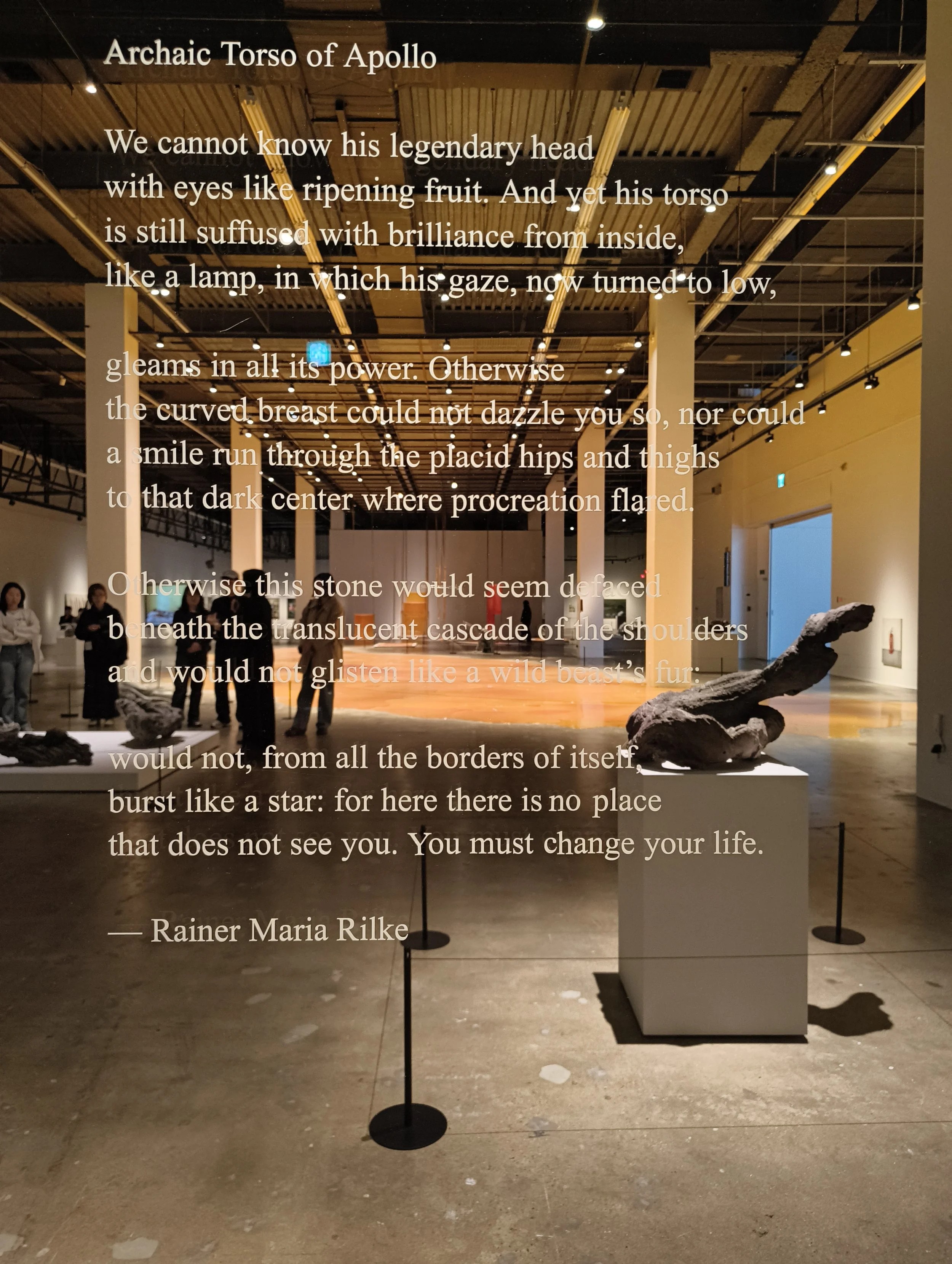
Archaic Torso of Apollo poem
by Rainer Maria Rilke
You Must Change Your Life, 16th Gwangju Biennale, Gwangju Biennale Exhibition Hall, 5 September–15 November 2026.